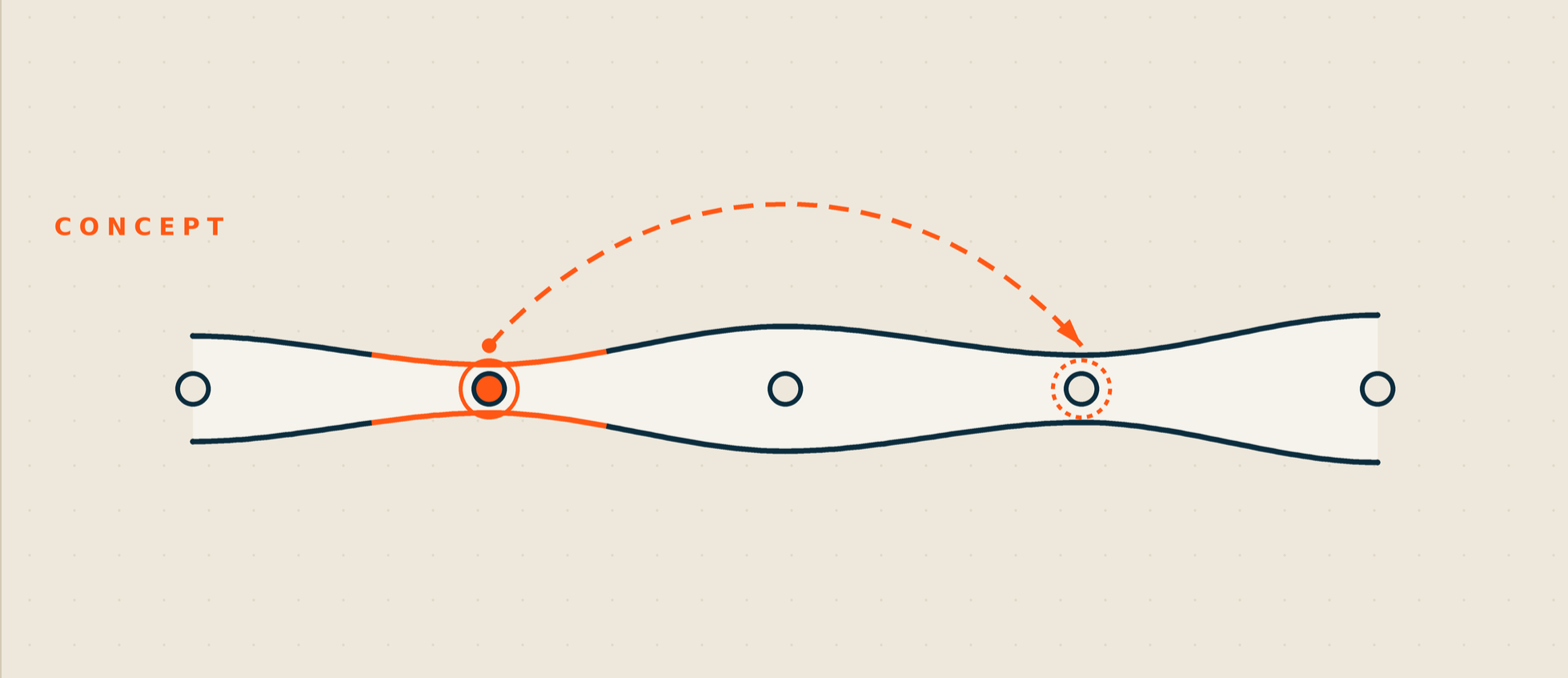
There is a principle in operations management called the Theory of Constraints, developed by Eliyahu Goldratt in the 1980s. The central idea is simple: every system has exactly one constraint at any given time, one step that limits the output of the whole process. Goldratt called it the bottleneck.
The practical implication is counterintuitive. Improving any part of a system that is not the current bottleneck produces no increase in overall output. If a factory can assemble 100 units per hour but can only package 60, improving assembly speed to 200 units per hour changes nothing. The constraint is packaging.
What happens when you do fix the actual constraint: the bottleneck moves. Bring packaging to 100 units per hour, and now something else (shipping, quality control, raw material supply) becomes the limit. A system under optimization never runs out of constraints. It just runs out of the current one.
This is the moving bottleneck. It is, I think, the most useful framework for understanding what AI is doing to knowledge work.
How Bottlenecks Have Shifted Before
Technology has been moving bottlenecks for a long time. It is worth tracing a few examples to see the pattern clearly.
Before industrial machinery, physical labor was the bottleneck in manufacturing. A craftsman could only work as fast as their hands allowed. Mechanization removed that constraint. Output per worker increased by orders of magnitude. But this did not make manufacturing problems disappear; it moved the bottleneck to coordination, logistics, and management. Running a factory efficiently became the new hard problem.
Before computers, calculation was the bottleneck in science, finance, and engineering. Teams of people called "computers" (their job title, not a machine) spent careers performing arithmetic. Electronic computation removed that constraint. Scientists could run calculations in seconds that previously took months. The bottleneck moved to data collection, model design, and interpretation of results.
Before search engines, finding information was the bottleneck in research. Libraries were physically finite and geographically constrained. The internet, and then search, removed that constraint. The bottleneck moved to evaluating information quality: knowing which sources were reliable, which results were relevant, and which questions were worth asking.
In each case, the technology did not eliminate the difficulty of the underlying task. It relocated that difficulty to a different part of the process.
The Current Shift: Execution to Judgment
For most of the history of software development, writing code was a significant bottleneck. Translating a problem into working software required specific technical skill, substantial time, and close attention to syntactic detail. Non-technical people who wanted software built had to either learn to code or depend entirely on developers. Developers spent significant portions of their time on implementation work that was, in retrospect, relatively mechanical.
AI coding tools have changed this. Tools like Claude Code, GitHub Copilot, and similar systems can now handle a meaningful portion of implementation. They write functions, suggest architectures, debug errors, and translate natural language descriptions into working code. The execution bottleneck has not disappeared, but it is substantially smaller than it was.
The bottleneck has moved.
What remains (and what these tools have not made significantly easier) is the judgment that precedes and follows execution. Defining the problem accurately. Understanding the user's actual need, which is often different from what they articulate. Choosing the right architecture for the problem's actual constraints. Knowing when a working solution is still the wrong one. Evaluating output against real-world criteria.
These tasks require context that is difficult to encode, domain knowledge that is often tacit, and judgment that depends on understanding the full situation, not just the immediate task. They are not, in principle, beyond what AI systems might eventually handle. But they are, in practice, what is currently hard.
The Pattern Generalizes
The shift from execution to judgment is not specific to software. The same dynamic appears wherever AI tools are productive.
In writing, AI can produce drafts quickly. The constraint moves to deciding what is worth writing, what argument is worth making, and whether a piece of communication actually achieves its purpose with the intended reader.
In legal work, AI can research case law and draft standard documents. The constraint moves to strategy, interpretation, and judgment about how a specific situation interacts with general rules: the parts that depend on understanding a particular client, a particular court, a particular set of facts.
In medicine, AI can analyze images and flag anomalies with accuracy that competes with specialists. The constraint moves to diagnosis in ambiguous cases, treatment decisions that depend on patient-specific context, and communication of findings to patients: tasks that depend on information that does not appear in the scan.
The pattern is consistent: AI reduces the cost of the rule-based, pattern-matching parts of the work. The constraint moves to the parts that require judgment about specific situations that do not fit neatly into prior patterns.
What This Means in Practice
The moving bottleneck framework suggests a specific way to think about where to develop skill and attention.
The instinct when a new tool becomes available is to master that tool. This makes sense: tools are often the proximate constraint, and using them well does matter. But if the bottleneck is moving, the more durable investment is in the capabilities that become valuable after the current bottleneck is removed.
For software work, this means developing better judgment about problem definition, system design, and evaluation, not instead of understanding AI tools, but alongside it, and with more emphasis than before.
More generally, the question worth asking about any productivity-enhancing technology is not only "how do I use this?" but "if I use this well, what becomes the new constraint?"
The answer to that question points to where skill development has the highest return over time.
A Note on Uncertainty
This analysis rests on an observation about the current state of AI tools, and that state is changing. The argument is not that judgment and problem definition will always remain difficult for AI systems. It is that they are currently harder than execution, and that the pattern of bottleneck movement has applied consistently to each prior wave of productivity technology.
Whether AI eventually moves the bottleneck further (into territory we currently consider irreducibly human) is a genuine open question. The honest answer is that no one knows. But acting on where the bottleneck is now, while paying attention to where it might move next, is the approach the framework itself recommends.